
Difference between stress and anxiety: a clear guide for your brain

You’re navigating the evening rush on Sheikh Zayed Road, your phone buzzing with notifications, your mind replaying a difficult conversation from your last meeting. Your shoulders are tight, your thoughts are racing. Is this stress? Or is it anxiety? In our fast-paced world, these two words are often used interchangeably, leaving many of us feeling both wired and worried, without a clear understanding of what’s happening in our own minds.
At NEUROVIA, we believe that clarity is the first step toward calm. Understanding the difference between stress and anxiety from the brain’s perspective isn’t about self-diagnosis; it’s about self-awareness. It’s about giving yourself the grace to respond to your internal state with wisdom and compassion, rather than frustration. This guide is designed to illuminate that difference, helping you navigate your inner world with greater confidence and ease.
Stress: The Brain’s Response to a Present Threat
Imagine you have a critical presentation in one hour. Your heart rate increases, your focus narrows, and you feel a surge of energy. This is stress. At its core, stress is the body and brain’s reaction to an external trigger or demand, known as a stressor. It’s a primal survival mechanism designed to help you handle an immediate challenge.
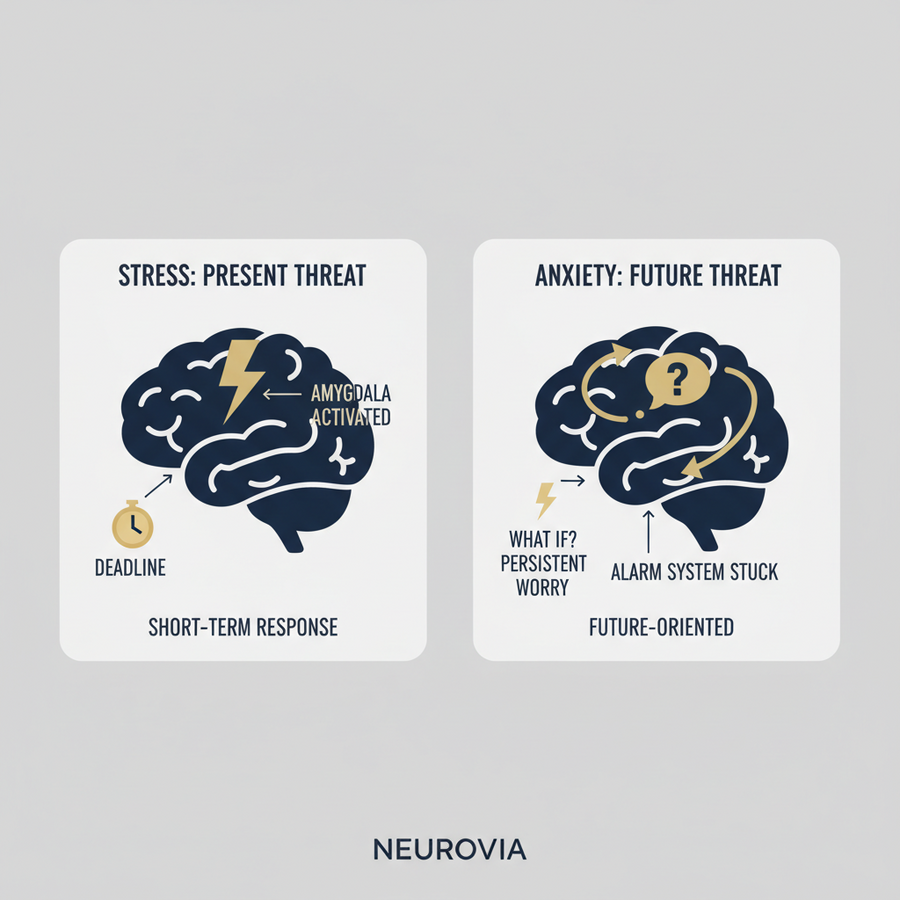
From a neurological perspective, when you perceive a threat—whether it’s a tight deadline or a sudden braking car—your brain’s alarm system, the amygdala, springs into action. It signals the release of hormones like adrenaline and cortisol, preparing your body for a “fight or flight” response. This process is incredibly effective for short-term challenges. In manageable doses, stress can even be positive (a concept called ‘eustress’), providing the motivation you need to perform under pressure and meet your goals.
The key characteristic of stress is its direct link to a specific, external cause. Once the presentation is over or the deadline is met, the stress response should subside, and your system should return to a state of balance.
Anxiety: The Brain’s Response to a Future Threat
Now, let’s look at a different scenario. The presentation is over—it even went well. But later that night, you find yourself lying awake, worrying about what your boss *really* thought, what might happen in next week’s performance review, and whether you’re truly on the right career path. This is anxiety.
Anxiety is an internal response that often persists long after a stressor has disappeared, or even arises without any obvious trigger at all. It is future-oriented, characterised by persistent, excessive worry about what *might* happen. The difference between stress and anxiety in the brain is subtle but significant. While stress is the activation of the alarm system in response to a real-time event, anxiety is when that alarm system becomes stuck in the ‘on’ position. The prefrontal cortex, responsible for planning and problem-solving, gets caught in a loop of “what-if” scenarios, and the amygdala remains on high alert, scanning for potential threats that haven’t occurred.
Unlike stress, which is a reaction to a situation, anxiety often feels more like a state of being—a pervasive feeling of unease or dread that colours your experience.
The Difference Between Stress and Anxiety Symptoms: How They Feel
While their origins differ, the physical and emotional sensations of stress and anxiety can feel similar, which is why they are so often confused. However, looking closely at the patterns can provide clarity.
When you’re stressed, you might notice:
- Irritability and short-temperedness.
- Fatigue and low energy.
- Muscle tension, particularly in the neck and shoulders.
- Headaches or digestive issues.
- Difficulty focusing on the task at hand.
- Feeling overwhelmed by your to-do list.
When you’re experiencing anxiety, you might notice:
- A persistent feeling of worry or dread that’s hard to control.
- Restlessness and an inability to relax.
- Difficulty concentrating because your mind is occupied with worry.
- Sleep disturbances, like trouble falling or staying asleep.
- Avoidance of situations that might trigger your worry.
- Physical symptoms like a racing heart or shortness of breath, even in a calm environment.
From Stressor to Worry Loop: When Stress Becomes Anxiety
In a city like Dubai, where the pressure to perform is constant and connectivity never sleeps, it’s easy for the brain to exist in a state of chronic stress. When your system is continuously flooded with stress hormones without adequate time to recover, your brain can adapt in an unhelpful way. It essentially learns that the world is a perpetually threatening place and begins to anticipate stressors before they even appear. This is often the bridge from chronic stress to persistent anxiety.
Your brain becomes highly efficient at creating worry loops, turning a single stressful event into a long-term pattern of anxious thinking. The good news is that the brain is also remarkably adaptable. Just as it can learn patterns of worry, it can also be guided back toward patterns of calm and focus. Training your brain to regulate its own responses is key to breaking the cycle.
To explore how NEUROVIA’s non-invasive brain training can support your mental wellbeing and help you cultivate resilience, you can visit our services page.
Managing the Difference Between Stress and Anxiety: Calm, Realistic Steps
Recognising whether you’re dealing with a present stressor or a future-focused worry can help you respond more effectively. The goal is not to eliminate these feelings entirely—they are a normal part of the human experience—but to manage them with greater skill.
For Managing Stress: Grounding in the Present
Since stress is tied to a specific trigger, the most effective approach is often practical and present-focused.
- Identify the Stressor: Clearly name what is causing the pressure. Is it a project, a person, or a situation?
- Break It Down: If the stressor is a large task, break it into smaller, manageable steps. This gives your brain a sense of control.
- Mindful Pauses: Step away from your desk for five minutes. Focus on your breath, feel your feet on the floor, or look out at the skyline. This simple act can reset your nervous system.
- Engage Your Body: A short walk, a few stretches, or even just tensing and releasing your muscles can help dissipate stress hormones.
For Managing Anxiety: Soothing the Future-Focused Mind
Since anxiety is an internal, thought-based experience, management often involves gently redirecting your attention and soothing your nervous system.
- Acknowledge the Worry: Instead of fighting the anxious thought, label it gently: “I am having a thought about the future.” This creates distance.
- Return to the Senses: Name five things you can see, four things you can feel, three things you can hear. This pulls your attention out of the future and back into the present moment.
- Practice Self-Compassion: Remind yourself that it’s okay to feel this way. Anxiety is a protective instinct that has simply gone into overdrive.
- Limit “What-If” Spirals: When you notice your mind spiraling, consciously shift your focus to something neutral and tangible, like making a cup of tea or organising a drawer.

How NEUROVIA Supports Your Brain’s Resilience
At NEUROVIA, we understand that managing stress and anxiety is not about willpower alone; it’s about helping your brain function more optimally. Our approach, including advanced neurofeedback training, works directly with your brain’s own patterns. In our calm and serene Dubai studio, we help you guide your brain toward a state of natural balance and regulation.
This isn’t about erasing challenges. It’s about building your brain’s capacity to navigate them with greater calm, clarity, and resilience, so that stress remains a temporary response, not a precursor to lasting anxiety. You can learn to quiet the internal noise and enhance your focus, performance, and overall quality of life.
If you feel ready to experience a new level of mental clarity and calm, you can book an appointment here.
FAQ
Is it possible to experience stress and anxiety at the same time?
Absolutely. They often coexist. For example, you might feel stressed about giving a presentation (a present trigger) while also feeling anxious about the long-term career implications if it doesn’t go perfectly (a future worry). They can feed off each other, creating a challenging cycle.
Can stress turn into an anxiety disorder?
Chronic, unmanaged stress is a significant risk factor for the development of anxiety disorders. When your body’s stress response is constantly activated, it can change the way your brain processes threats, making you more susceptible to persistent anxiety. While this article provides information, a formal diagnosis must always come from a qualified healthcare professional.
Are techniques for managing stress and anxiety the same?
There is significant overlap, as many techniques like mindfulness, exercise, and proper sleep are beneficial for both. However, the specific focus often differs. Stress management frequently involves practical, problem-solving strategies to address the external trigger, while anxiety management focuses more on shifting internal thought patterns and calming the nervous system.
What if I can’t tell the difference in my own experience?
That is completely normal and very common. The most important thing is not to get overly concerned with applying the perfect label. Instead, focus on noticing how you feel without judgment and taking small, gentle steps to support your mental wellbeing. Sometimes, the simple act of paying attention is the most powerful tool you have.
Understanding the distinction between stress and anxiety empowers you to change your relationship with your own mind. It moves you from a place of confusion to one of clarity, where you can offer yourself the right kind of support at the right time. Your mind is not your enemy; it is a complex and powerful system that, with the right tools and guidance, can be your greatest ally in creating a life of balance and wellbeing.
Disclaimer: The information provided in this article is for educational purposes only and is not intended as a substitute for professional medical advice, diagnosis, or treatment. Always seek the advice of your physician or another qualified health provider with any questions you may have regarding a medical condition.