
Cognitive symptoms of overload: a clear guide for your brain

You’re in an important meeting, ready to make a point, and the name of a key colleague vanishes from your mind. Or perhaps you walk into a room, bathed in the soft afternoon light of your Dubai apartment, only to stand still, completely forgetting why you came. These moments of mental fog, forgotten words, and fractured focus are more than just frustrating; they are signals from a mind that is carrying too much.
These experiences are often the cognitive symptoms of overload—the subtle, yet significant, ways our brain tells us it has reached its processing capacity. In a world that prizes constant connectivity and productivity, it’s easy to dismiss these signs as personal failings. But what if we saw them not as flaws, but as a neutral, biological response to an environment that demands too much?
This guide offers a calm, clear look at the cognitive symptoms of overload from the brain’s perspective. Here, we explore what’s happening beneath the surface and how you can respond with gentle, realistic strategies, free from self-blame.
Understanding Your Brain on Overload
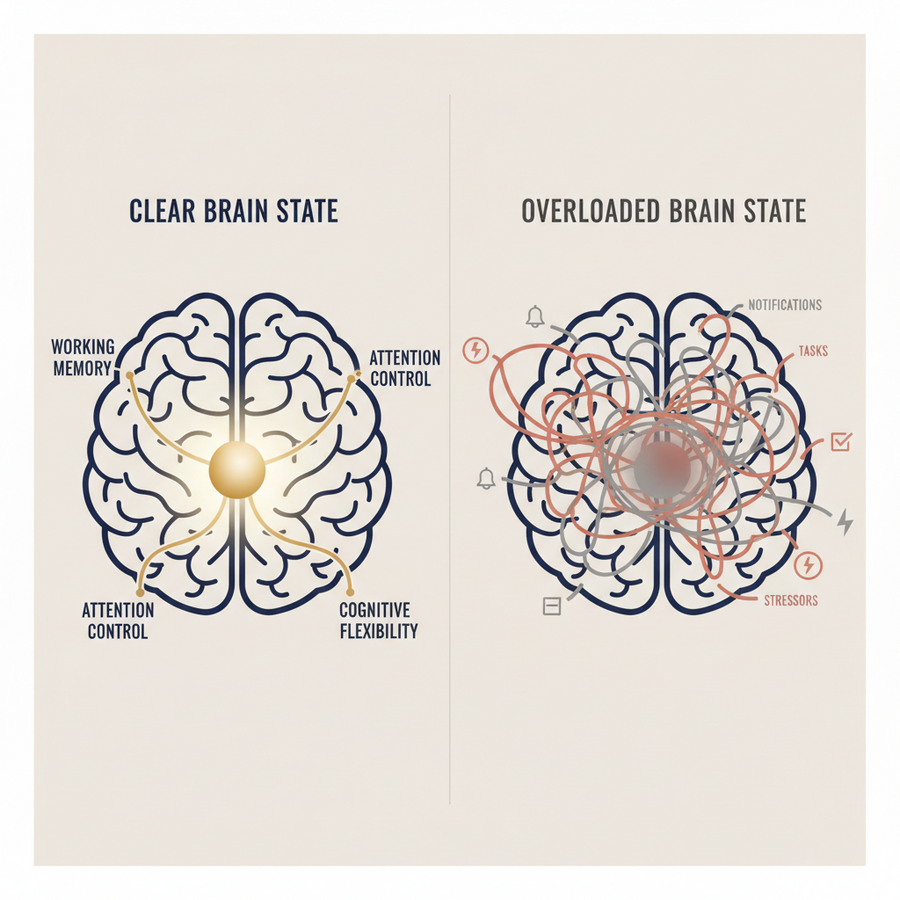
Think of your brain’s attention and decision-making resources as a pristine, quiet workspace. In an ideal state, the desk is clear, the light is soft, and you can focus entirely on the task at hand. Cognitive overload is what happens when hundreds of files are suddenly piled on that desk, notifications are flashing, and the phone is ringing incessantly. The space becomes chaotic, and productive thought becomes nearly impossible.
Scientifically, this relates to our brain’s executive functions, a set of mental skills managed by the prefrontal cortex. These functions include:
- Working Memory: The ability to hold and manipulate information for short periods (like remembering a phone number while you dial it).
- Attention Control: The capacity to focus on relevant information while filtering out distractions.
- Cognitive Flexibility: The skill of switching between different tasks or ways of thinking.
When we are overloaded with information, stress, or constant task-switching, these executive functions become strained. The brain, trying to conserve energy, begins to operate less efficiently. The result isn’t a lack of effort on your part; it’s a physiological traffic jam in your neural pathways.
The Most Common Cognitive Symptoms of Overload Symptoms
Recognising these symptoms is the first step toward managing them. They often appear subtly at first, but can build until they significantly impact your daily life. Here are some of the most common signs that your cognitive load is too high.
Memory Lapses
This is perhaps the most noticeable symptom. You might forget appointments, misplace your keys more often, or struggle to recall details from a conversation you just had. This isn’t a sign of premature aging; it’s your working memory failing to encode new information properly because its “RAM” is already full.
Brain Fog
Brain fog is a pervasive feeling of mental slowness, haziness, or being “spaced out.” It feels like trying to think through a thick cloud. Tasks that are usually simple can feel monumental, and articulating your thoughts can become a genuine struggle. The cognitive symptoms of overload in the brain often manifest as this reduced processing speed.
Difficulty Concentrating
You sit down to read a report, but your mind wanders after just a few sentences. You find yourself re-reading the same email multiple times without absorbing its content. This difficulty maintaining focus happens because your brain’s attentional filter is overwhelmed, allowing distractions to flood in easily.
Decision Fatigue
When your brain is overloaded, even the smallest choices—what to have for dinner, which email to answer first—can feel exhausting. This “decision fatigue” occurs because every choice, big or small, consumes mental energy. When your reserves are low, your brain defaults to avoiding decisions altogether or making impulsive, less-thought-out ones.
Heightened Irritability and Emotional Reactivity
When your cognitive resources are depleted, your ability to regulate emotions suffers. You might find yourself snapping at a loved one, feeling disproportionately frustrated by traffic on Sheikh Zayed Road, or reacting emotionally to minor workplace setbacks. Your brain simply doesn’t have the bandwidth left to manage emotional responses with its usual patience.
Daily Life in a State of Overload
These symptoms don’t exist in a vacuum. They ripple through our work, our relationships, and our sense of self. At work, it might look like missing deadlines, feeling disconnected from your team, or a drop in the quality of your creative thinking. At home, it can lead to a feeling of being constantly behind on chores, having less patience with your family, and being too mentally drained to enjoy your downtime.
The quiet tragedy is that we often internalise these symptoms, believing we are becoming less capable or less intelligent. The truth is far more compassionate: your brain is simply sending a clear signal that it needs a different environment to thrive.
To explore how NEUROVIA can support your mental wellbeing and help you build resilience against overload, you can visit our services page.
Responding with Calm: Managing Cognitive Symptoms of Overload
The solution to overload isn’t to “try harder.” It’s to work smarter with your brain’s natural rhythms. This involves creating pockets of calm and clarity in your day and cultivating mental hygiene practices that protect your cognitive resources.

Embrace Single-Tasking
The modern myth of multitasking is one of the biggest contributors to cognitive overload. The brain doesn’t truly multitask; it rapidly switches between tasks, which is incredibly inefficient and energy-intensive. Practice focusing on one thing at a time. Close unnecessary tabs, put your phone on silent, and dedicate a block of time to a single priority. You’ll find you accomplish more with less mental strain.
Build in Strategic Pauses
Just as an athlete needs recovery, your brain needs moments of intentional rest. These don’t have to be long. A five-minute pause to look out the window, stretch, or simply breathe can be enough to reset your focus. Think of it as creating a moment of serene, uncluttered space—like the clean, minimalist calm of our NEUROVIA studio—right in the middle of your busy day.
Curate Your Information Diet
You are in control of the information you consume. Turn off non-essential notifications on your phone and laptop. Schedule specific times to check emails rather than reacting to them as they arrive. Unsubscribe from newsletters you don’t read. Each small act of curation reduces the cognitive “noise” your brain has to filter.
Prioritise Restorative Sleep
Sleep is non-negotiable for cognitive health. During deep sleep, your brain works to clear out metabolic waste products that accumulate during the day and consolidates memories. Protecting your sleep is one of the most powerful things you can do to manage the cognitive symptoms of overload.
If you feel ready to experience a session designed to support your brain’s natural ability to find calm and focus, you can book an appointment here.
FAQ
Is brain fog the same as a cognitive symptom of overload?
Brain fog is one of the most common cognitive symptoms of overload. While overload refers to the state of having too much information for the brain to process effectively, brain fog is the subjective feeling of mental slowness and lack of clarity that results from it. They are closely linked, but not exactly the same thing.
Are these symptoms a sign of a serious medical condition?
For most people, these cognitive symptoms are a temporary response to high stress and overload. However, if they are persistent, severe, or accompanied by other worrying symptoms, it is always wise to consult with a medical professional to rule out any underlying conditions. NEUROVIA provides support for mental wellbeing and brain training, not medical diagnosis or treatment.
Can these cognitive symptoms of overload be completely eliminated?
In our modern world, experiencing some level of overload is almost inevitable. The goal isn’t necessarily to eliminate it entirely, but to build the resilience and awareness to manage it effectively. By implementing better mental hygiene and using tools that support neural regulation, you can significantly reduce the frequency and intensity of these symptoms and recover from them more quickly.
Ultimately, noticing the cognitive symptoms of overload is an invitation to listen more closely to your brain. It’s a call to trade the relentless pursuit of “more” for a more sustainable, intentional way of living—one that honors your mental wellbeing as the precious resource it is.
Disclaimer: The information provided in this article is for educational and informational purposes only and is not intended as medical advice. It should not be used to diagnose, treat, or prevent any medical condition. Please consult with a qualified healthcare professional for any health concerns or before making any decisions related to your health or treatment.