Chronic stress at work: simple daily practices you can actually keep

Does this week feel familiar? A cascade of back-to-back meetings, a constant stream of notifications painting your screen with urgency, and a to-do list that seems to regenerate overnight. For many founders and managers in Dubai, this isn’t just an occasional challenging week; it’s a state of being. You might end your day feeling both wired and exhausted, as though you’ve been running a marathon while sitting at your desk. It’s the sensation of your internal engine being stuck in a high gear—the feeling of a permanent ‘fight-or-flight’ response.
This persistent state of high alert is often a sign of chronic stress at work. It’s more than just having a busy job; it’s when your nervous system no longer returns to a calm baseline. Your mind and body remain braced for a threat that never fully subsides. The good news is that you don’t need to overhaul your entire life to find relief. This article explores practical, brain-friendly steps to gently guide your system back towards balance, designed for busy people who need change that fits into the life they already have.
Understanding the ‘Always On’ Brain
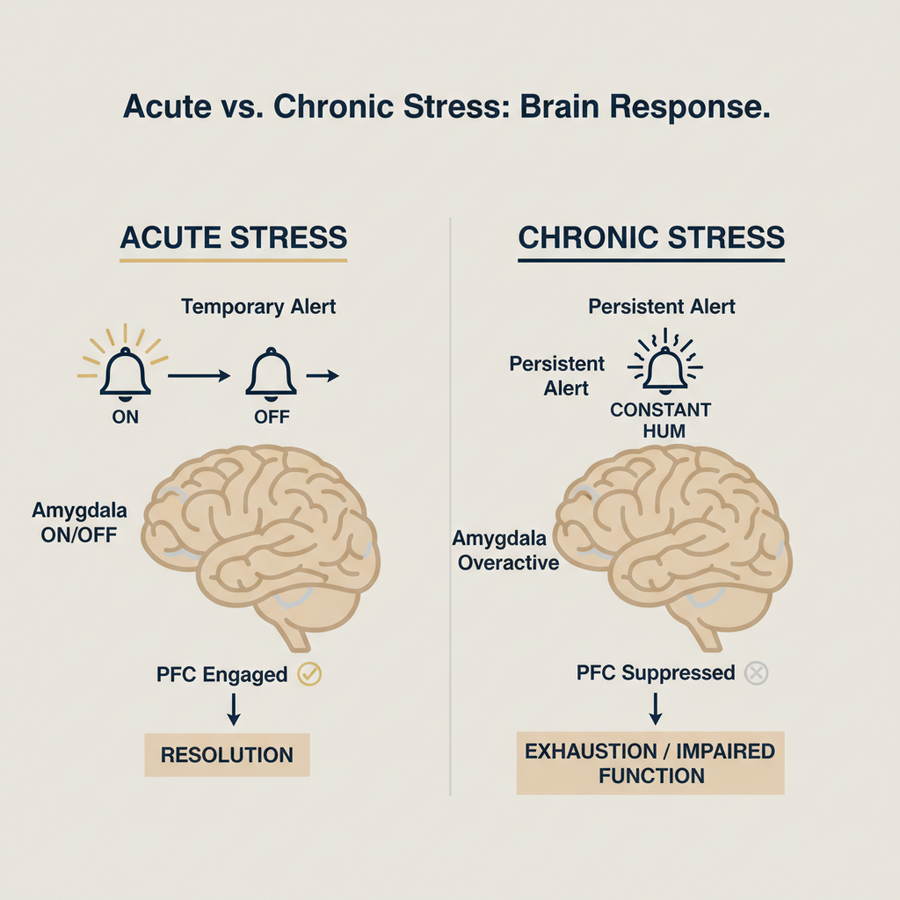
Our brains are wired for survival. Acute stress—the kind you feel before a big presentation—is a powerful, useful tool. It floods your system with cortisol and adrenaline, sharpening your focus for a short period. Think of it as a fire alarm: it blares when there’s a specific danger and switches off once the threat is gone. You handle the challenge, and your body returns to rest.
The problem with chronic stress at work is that the alarm never truly turns off. It hums constantly in the background, a low-grade signal of perpetual threat. This has a direct impact on the chronic stress at work brain. Your amygdala, the brain’s threat detection centre, becomes overactive. It starts flagging routine emails and minor setbacks as urgent dangers. Meanwhile, your prefrontal cortex—the hub for rational thought, planning, and emotional regulation—gets less energy and blood flow. This is why, under chronic stress, you might feel more reactive, impulsive, and find it harder to think clearly and strategically.
What Chronic Stress at Work Symptoms Look Like in Daily Life
Because it builds gradually, we often normalise the feeling of being perpetually stressed. We might dismiss it as just “the nature of the job.” But these subtle symptoms are your body’s way of signalling that its resources are depleted. Recognising them is the first step toward addressing them.
Cognitive and Emotional Signs
- Persistent brain fog: A feeling of mental cloudiness that makes it hard to focus or recall information.
- Decision fatigue: Simple choices feel overwhelming, and you find yourself putting off important decisions.
- Heightened irritability: You have a shorter fuse with colleagues, family, or even Dubai’s traffic.
- A sense of dread: Waking up with a feeling of anxiety or resistance towards the workday ahead.
Physical Manifestations
- Unexplained fatigue: You feel tired even after a full night’s sleep, relying on caffeine to get through the day.
- Chronic muscle tension: A stiff neck, tight shoulders, or persistent lower back pain are common signs.
- Frequent headaches: Tension headaches become a regular part of your work week.
- Disrupted sleep: You might struggle to fall asleep, wake up multiple times during the night, or wake up feeling unrefreshed.
The Ripple Effect: From the Office to Your Evening in Dubai
One of the most challenging aspects of chronic stress is its inability to stay contained. It doesn’t switch off when you power down your laptop. It follows you onto Sheikh Zayed Road, replaying a difficult conversation from your last meeting. It sits with you at the dinner table in a beautiful Marina restaurant, pulling your attention back to your phone with every phantom vibration. This inability to disconnect means your brain and body are never truly getting the restorative downtime they need to recover.
This ‘spillover’ affects your personal life, straining relationships and diminishing your capacity to enjoy the life you work so hard to build. True rest becomes elusive, and the cycle of stress continues, with each day starting from a deeper deficit.
Managing Chronic Stress at Work: Small Shifts, Big Impact
The key to managing chronic stress at work isn’t about adding more to your plate. It’s about integrating small, intentional moments of regulation into your existing routine. Think of it as mental hygiene—simple practices that clear the noise and calm the nervous system.
1. The Five-Minute Boundary
Create a buffer between your work and personal life. When you finish your workday, before you walk into your home, take five minutes in your car or just outside your door. Put your phone away. Turn off the radio. Simply sit in silence and take a few slow, deep breaths. This small ritual signals to your brain that the ‘work’ part of the day is over, creating a mental boundary that prevents stress from following you inside.
2. Mindful Monotasking
Our brains are not designed for multitasking. Juggling multiple tabs, conversations, and tasks simultaneously fragments your attention and puts a heavy tax on your prefrontal cortex. Try practicing ‘monotasking’. Set a timer for 25 minutes and dedicate your full attention to a single task. Close all other tabs. Silence your notifications. When the timer goes off, you can take a short break before starting the next block. You’ll likely find you accomplish more with less mental strain.
3. Conscious Disconnection
Intentionally schedule moments of disconnection. This could be a 20-minute walk at lunchtime without your phone, or dedicating the first hour after you get home to be completely screen-free. This practice gives your brain a much-needed break from the constant influx of information and allows your nervous system to down-regulate.
While these practices are powerful, sometimes the nervous system needs more direct support to learn how to regulate itself. This is where brain training comes in, offering a way to work directly with your brain’s patterns. To explore how NEUROVIA can support your mental wellbeing, you can visit our services page.

How NEUROVIA Supports a Calmer, More Resilient Mind
At NEUROVIA, we understand that you can’t always change the external pressures of your work. Our approach focuses on changing your brain’s response to those pressures. In our calm, focused studio—a sanctuary designed with clean lines and a palette of deep navy, sand, and warm gold—we use advanced neurofeedback technology to help you build mental resilience from the inside out.
Think of it as a guided meditation for your brain, backed by science. During a session, sensors provide real-time feedback on your brainwave activity. This feedback helps your brain learn to shift itself out of high-alert, stressed states and into calmer, more focused ones. Over time, this training strengthens the neural pathways for regulation, making it easier for you to access a state of calm and clarity, even in the middle of a demanding day. It’s not about eliminating stress, but about improving your ability to navigate it effectively, enhancing your performance without the cost of burnout.
FAQ
Is chronic stress the same as burnout?
They are related, but not the same. Chronic stress is the long road of being in a constant state of high alert. Burnout is often the destination at the end of that road, characterised by profound emotional exhaustion, cynicism towards your job, and a feeling of professional ineffectiveness. Actively managing chronic stress is a crucial step in preventing burnout.
I don’t have time for complex wellness routines. Can I still make a difference?
Absolutely. The approach we advocate is built on the power of micro-habits. Consistency is far more important than intensity. A five-minute breathing exercise done daily will have a much greater impact on your nervous system than a two-hour wellness ritual you only manage once a month. The goal is to find small, sustainable shifts that you can actually keep.
How does brain training at NEUROVIA actually work for stress?
It works on the principle of neuroplasticity—the brain’s ability to change and adapt. Neurofeedback provides your brain with a mirror, showing it its own activity in real time. When your brain produces calmer, more focused brainwaves, you receive positive feedback (like a pleasant sound or visual). This process reinforces those desired patterns, essentially training your brain to self-regulate more efficiently. It’s a non-invasive way to build a more resilient and flexible nervous system.
Living in a state of permanent ‘fight-or-flight’ does not have to be your default. By understanding the signals your brain and body are sending, and by integrating small, intentional practices into your day, you can begin to reclaim a sense of calm and control. You can perform at your best without sacrificing your wellbeing.
If you feel ready to experience a session and explore how you can support your brain’s health, you can book an appointment here.
Disclaimer: The information in this article is for educational purposes only and is not intended to be a substitute for professional medical advice, diagnosis, or treatment. Always seek the advice of your physician or other qualified health provider with any questions you may have regarding a medical condition.