
High functioning anxiety signs: myths, realities and what your brain really does

From the outside, your life is a picture of success. Perhaps it’s a high-floor office with a sweeping view of the Dubai skyline, a calendar filled with important meetings, or the quiet satisfaction of a project flawlessly executed. You are ambitious, accomplished, and the person everyone relies on to get things done. Yet, beneath this polished surface, there’s a quiet, persistent hum of unease. A feeling that if you stop moving for even a moment, it will all fall apart.
This experience, often described as ‘high-functioning anxiety,’ is not a formal medical diagnosis, but it is a deeply real and increasingly common reality for many professionals. It’s the paradox of appearing calm and in control while internally navigating a storm of worry, self-doubt, and relentless pressure. This article will explore the common myths and realities behind high functioning anxiety signs, what science suggests is happening in your brain, and how you can relate to your own experience with more kindness and clarity.
The Polished Exterior: A Myth of Effortless Success
One of the greatest myths surrounding high-functioning anxiety is that achievement equals contentment. We see the meticulously organised colleague, the friend who juggles a demanding career and family life with apparent ease, or even ourselves, and assume the external success is a reflection of internal peace. The reality is often the complete opposite.
The very traits that fuel success—diligence, attention to detail, proactive planning—can be the external expression of an inner engine running on nervous energy. The perfectly planned project is driven by a fear of making a mistake. The punctuality is fuelled by a deep-seated worry about letting others down. This creates a challenging cycle: the anxiety drives the achievement, and the achievement temporarily quiets the anxiety, reinforcing the pattern. But the relief is always fleeting.
The Inner Landscape: Common High Functioning Anxiety Signs and Symptoms
If the outward appearance is one of composure, what does the internal experience feel like? Recognising the inner world is the first step toward understanding and balance. Here are some of the most common high functioning anxiety signs symptoms that play out behind the scenes:
- Constant Overthinking and Rumination: Your mind is always ‘on.’ You replay conversations, analyse past decisions, and game out dozens of future scenarios, often focusing on the worst possible outcome. It’s like having a browser with too many tabs open, all of them demanding your attention.
- The Perfectionism-Procrastination Loop: You hold yourself to impossibly high standards. The fear of not meeting them can be so paralysing that you delay starting a task. This leads to a frantic, last-minute burst of high-stress work to meet the deadline, which, while successful, leaves you feeling drained and reinforces the belief that you only perform well under pressure.
- Difficulty Relaxing or ‘Switching Off’: True rest feels elusive. Even during downtime—a quiet evening at home or a weekend brunch—your mind is racing with to-do lists, work problems, or a vague sense of dread you can’t quite name. The calm atmosphere of a beach club might be lost on a mind that is still back in the office.
- People-Pleasing and Fear of Saying ‘No’: You might overcommit at work or in your social life because the thought of disappointing someone feels unbearable. This often leads to a packed schedule and a feeling of being stretched too thin, putting everyone else’s needs before your own.
- Persistent Negative Self-Talk: Despite external validation, your inner critic is relentless. You might dismiss compliments, downplay your achievements as ‘luck,’ and focus intensely on any perceived flaw or mistake.
- Physical Manifestations: The mind and body are deeply connected. This constant state of high alert can manifest physically as tension headaches, muscle aches (especially in the neck and shoulders), digestive issues, or a racing heart before a seemingly routine event.
- Sleep Disturbances: You may find it hard to fall asleep as your brain refuses to quiet down, or you might wake up at 3 a.m. with a jolt of adrenaline, your mind already compiling the next day’s worries.
To explore how NEUROVIA can support your mental wellbeing journey and help you cultivate a calmer internal state, you can visit our services page.
What Your Brain Really Does: The Neuroscience of a Mind on High Alert
When you experience these signs, it’s not a personal failing; it’s a reflection of your brain’s threat-detection system working in overdrive. Understanding the high functioning anxiety signs brain connection can be incredibly empowering.
At its core, this experience involves two key parts of your brain: the amygdala and the prefrontal cortex.
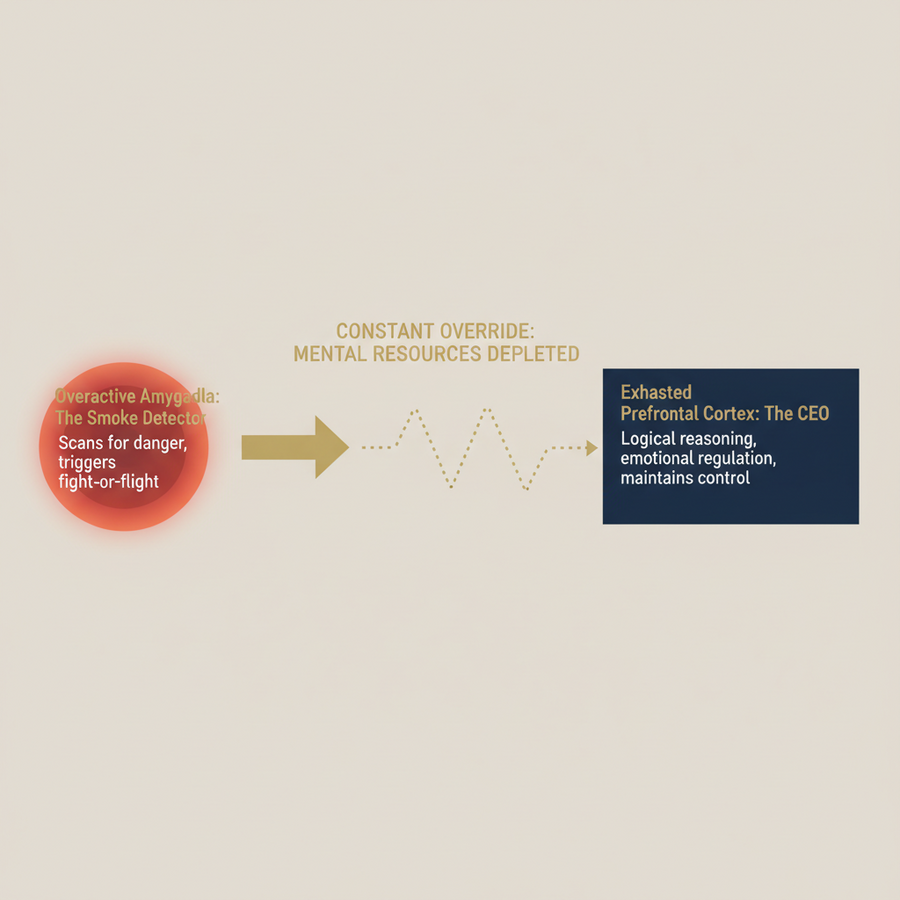
- The Overactive Amygdala: Think of the amygdala as your brain’s smoke detector. Its job is to scan for danger and trigger the ‘fight-or-flight’ response. In a state of high-functioning anxiety, this detector becomes overly sensitive. It starts perceiving non-threatening situations—like an ambiguous email from your boss, a looming deadline, or a crowded social event—as genuine threats. It floods your system with stress hormones like cortisol and adrenaline, keeping you in a constant state of low-grade alert.
- The Exhausted Prefrontal Cortex: Your prefrontal cortex is the ‘CEO’ of your brain. It’s responsible for logical reasoning, impulse control, and emotional regulation. When the amygdala sounds the alarm, the prefrontal cortex works hard to assess the situation logically and maintain control. This is why you can still deliver a perfect presentation while your heart is pounding. But this constant override is mentally exhausting. It consumes a vast amount of cognitive energy, leaving you feeling depleted and making it harder to focus on creative, high-level thinking.
Essentially, you are using tremendous mental resources just to appear calm and function effectively. It’s a testament to your resilience, but it is not a sustainable way to live.
From Coping to Thriving: Managing High Functioning Anxiety Signs
The goal isn’t to eliminate ambition or stop caring about your work. It’s about shifting the fuel source from fear to focus, and from pressure to purpose. Managing high functioning anxiety signs involves learning to gently regulate your nervous system and cultivate new mental habits.
Mindful Awareness: Noticing Without Judgment
The first step is simply to notice. When your thoughts are racing, can you pause and observe them as if they were clouds passing in the sky, without getting swept up in the storm? This practice of mindful awareness creates a small but crucial space between you and your anxious thoughts, giving you the power to choose how you respond.
Strategic Rest: Redefining ‘Downtime’
For a high-functioning mind, rest is not a luxury; it is a strategic necessity. This means scheduling non-negotiable downtime where the goal is truly to do nothing productive. It could be a walk without your phone, listening to calming music, or simply sitting and watching the sunset. This gives your prefrontal cortex a chance to recharge and your nervous system a chance to downshift.
Embracing ‘Good Enough’
Perfectionism is often the anchor of anxiety. The antidote is to intentionally practice embracing ‘good enough.’ This doesn’t mean producing sloppy work; it means recognising the point of diminishing returns, where the extra 20% of effort only increases your stress, not the quality of the outcome. Submitting a project that is 90% perfect and on time is far more sustainable than an all-night effort for an imagined 100%.

Your Journey to Mental Clarity at NEUROVIA
At NEUROVIA, we understand the unique pressures faced by ambitious professionals. Our studio, designed as a sanctuary of calm with clean lines and a soothing palette of deep navy, gold, and sand, provides a space to step away from the relentless pace of city life. We utilise advanced, non-invasive brain-training technologies designed to help you strengthen your brain’s own ability to self-regulate.
Think of it as personal training for your brain. By providing real-time feedback on your brainwave activity, our sessions guide your brain towards more balanced, efficient, and resilient patterns. This process can help quieten the overactive stress response, enhance focus, and improve your ability to access a state of calm clarity, even under pressure. It’s not about changing who you are; it’s about giving you the tools to be your best self, without the constant burden of anxiety.
If you feel ready to experience a new approach to mental wellbeing, you can book an appointment here.
FAQ
Is high-functioning anxiety a real medical diagnosis?
No, ‘high-functioning anxiety’ is not a clinical diagnosis found in medical manuals like the DSM-5. It’s a term used to describe the lived experience of people who manage their daily responsibilities successfully while internally struggling with significant anxiety symptoms. An individual experiencing these signs might meet the criteria for a formal diagnosis like Generalised Anxiety Disorder (GAD), and a consultation with a qualified healthcare professional is recommended for assessment.
Can you be successful and still have anxiety?
Absolutely. This is the very definition of the high-functioning experience. Success can even become a source of anxiety, creating pressure to maintain a certain level of performance and a fear of being ‘found out’ as not good enough. Many of the world’s most accomplished individuals navigate this internal dynamic daily.
How can brain training help with these signs?
Brain training, such as the neurofeedback methods we use at NEUROVIA, works by enhancing your brain’s neuroplasticity—its ability to learn and form new pathways. It provides feedback that helps your brain learn to shift out of hyper-aroused, anxious states and into calmer, more focused ones. It’s a gentle, data-driven way to improve your brain’s resilience and self-regulation skills over time.
Will I have to stop being ambitious to manage my anxiety?
Not at all. The goal is to create sustainable ambition. It’s about learning to pursue your goals from a place of grounded energy and clear focus, rather than from a place of fear-driven urgency and impending burnout. Managing anxiety can actually unlock more creative and effective energy, enhancing your performance in the long run.
Recognising yourself in these descriptions is a powerful first step. Your experience is valid, and you are far from alone. By understanding the myths, the realities, and the mechanics of your own brain, you can begin to move from a life of high-functioning coping to one of high-achieving wellbeing.
Disclaimer: The information in this article is for educational purposes only and is not intended to be a substitute for professional medical advice, diagnosis, or treatment. Always seek the advice of your physician or other qualified health provider with any questions you may have regarding a medical condition.