
Acute vs chronic stress: a clear guide for your brain

Imagine two scenarios. In the first, you receive an urgent email from a key client requiring a response within the hour. Your heart rate quickens, your focus narrows, and you work with sharp efficiency to resolve the issue. An hour later, the email is sent, and a wave of relief washes over you. In the second, you feel a low-level hum of pressure that never quite turns off—the constant stream of notifications, the weight of long-term project goals, the feeling of being perpetually behind. It’s the subtle backdrop to your days and the quiet thief of your sleep.
Both scenarios involve stress, but they are profoundly different experiences for your brain and body. As a professional navigating the vibrant, fast-paced world of Dubai, understanding this distinction is the first step toward reclaiming your mental clarity and energy. This is not about eliminating stress, but about learning to navigate its currents with wisdom and self-awareness. Let’s explore the critical difference between acute vs chronic stress from the brain’s perspective.
Understanding Stress: Your Brain’s Ancient Alarm System
At its core, the stress response is a brilliant piece of evolutionary engineering. When your brain perceives a threat—whether it’s a tiger in the wild or a looming deadline—a small, almond-shaped region called the amygdala sounds an alarm. This triggers a cascade of hormones, primarily adrenaline and cortisol, preparing your body for immediate action. This is the famed “fight-or-flight” response.
Think of it as the most sophisticated smoke detector imaginable. It’s designed to be highly sensitive to protect you from danger. In the right context, it sharpens your senses, boosts your energy, and helps you perform under pressure. The key, however, is that the alarm is supposed to turn off once the perceived threat has passed.
What is Acute Stress? The Short Sprint
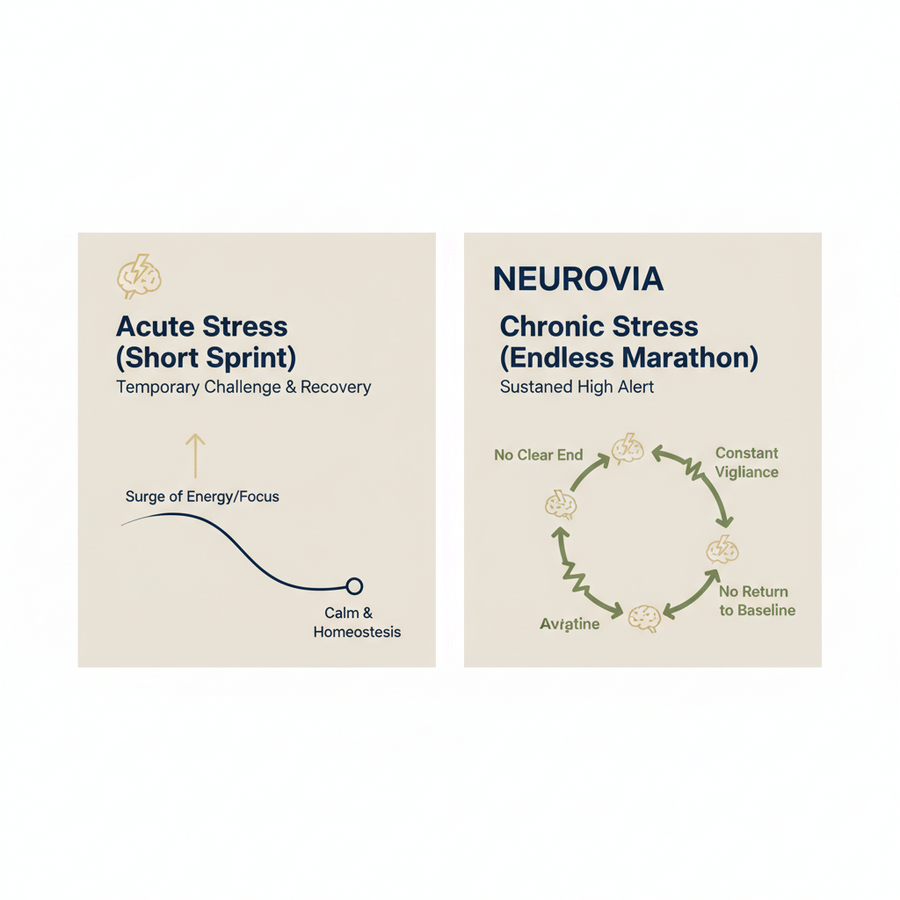
Acute stress is your brain’s response to a specific, short-term challenge. It’s the fire drill. It’s intense, immediate, and, crucially, it has a clear beginning and end. This is the kind of stress that helps you swerve to avoid a car on Sheikh Zayed Road, deliver a compelling presentation, or meet that sudden, unexpected deadline.
When the event is over, your parasympathetic nervous system takes over, applying the brakes. It lowers your heart rate, deepens your breath, and guides your body back to a state of calm equilibrium, known as homeostasis. In this form, stress can be beneficial, even exhilarating. It’s a sign that your nervous system is working exactly as it should.
Acute Stress Symptoms: The Body’s All-Clear
The signs of an acute stress response are unmistakable and designed for peak performance. Some common acute vs chronic stress symptoms in their short-term form include:
- A surge of adrenaline, leading to increased heart rate and energy.
- Sharpened focus on the immediate task at hand.
- Rapid, shallow breathing to oxygenate your muscles.
- A temporary decrease in functions not essential for immediate survival, like digestion.
What is Chronic Stress? The Endless Marathon
Chronic stress is what happens when the alarm never gets switched off. It’s a prolonged state of high alert, where your brain perceives threats as constant and inescapable. Unlike the sprint of acute stress, this is a grueling marathon with no finish line in sight.
This state isn’t caused by a single event, but by the relentless accumulation of pressures: a demanding job with long hours, persistent financial worries, difficult personal relationships, or even the subtle, pervasive pressure of a hyper-connected digital life. Your brain and body remain flooded with stress hormones, with no opportunity for recovery.
Chronic Stress Symptoms: When the Alarm Won’t Turn Off
When the system is constantly activated, it begins to wear down. The symptoms are more subtle and pervasive than those of acute stress, often creeping in so slowly that they begin to feel normal. They include:
- Persistent fatigue and a feeling of being “tired but wired.”
- Sleep disturbances, such as difficulty falling asleep, staying asleep, or waking up feeling unrested.
- Brain fog, memory problems, and difficulty concentrating.
- Increased irritability, anxiety, or a low, flat mood.
- Digestive issues or a weakened immune system, leading to more frequent colds.
- Changes in appetite or reliance on caffeine or sugar for energy.
The Key Difference: Acute vs Chronic Stress and Your Brain
The fundamental distinction between acute vs chronic stress lies in one word: recovery. The acute stress response is healthy because it is followed by a period of rest and repair. Your nervous system recalibrates, and your energy reserves are replenished. This cycle is essential for resilience.
Chronic stress, however, disrupts this vital cycle. The constant presence of cortisol can begin to impact the brain’s structure and function, particularly in areas related to memory (hippocampus) and decision-making (prefrontal cortex). The problem isn’t the stress itself; it’s the relentless, uninterrupted exposure to it. Your brain, in its effort to protect you, gets stuck in survival mode.
Recognizing this helps to reframe the goal. It’s not about heroically pushing through an impossible workload; it’s about consciously building moments of recovery and safety into your day, signaling to your brain that the “threat” has passed.
Managing Acute vs Chronic Stress: A Calmer Approach
Navigating stress is less about brute force and more about gentle regulation. It’s about understanding your brain’s signals and responding with intention rather than reacting on autopilot. This is a core part of developing robust mental wellbeing.
Responding to Acute Stress
When you feel that familiar spike of acute stress, the goal is to help your nervous system complete the cycle. After the event has passed, try these simple actions:
- Deep Breathing: Take a few slow, deep belly breaths. A long exhale signals safety to your brain.
- Physical Movement: A short walk, a few stretches—anything to release the physical tension.
- Sensory Grounding: Notice five things you can see, four you can touch, three you can hear. This pulls your attention back to the present moment.
Addressing Chronic Stress
Managing the low-grade, constant hum of chronic stress requires a more foundational approach. It’s about creating a lifestyle that prioritizes nervous system regulation.
- Protect Your Sleep: Treat sleep as a non-negotiable pillar of your wellbeing. Create a calming, screen-free wind-down routine.
- Set Boundaries: This could mean turning off email notifications after a certain hour or scheduling focused work blocks to avoid constant multitasking.
- Schedule ‘Nothing’ Time: In a culture that glorifies busyness, intentionally scheduling moments of stillness—without a goal or a to-do list—is a powerful act of recovery.
Building these habits can feel like another item on an already long to-do list. At NEUROVIA, our approach is designed to support your brain’s own ability to regulate and build resilience from the inside out, making it easier to navigate daily pressures with calm and clarity. To explore how NEUROVIA can support your mental wellbeing, you can visit our services page.

FAQ
Can acute stress turn into chronic stress?
Yes, absolutely. If acute, high-pressure events happen too frequently without adequate time for your nervous system to recover and return to its baseline, the cumulative effect can lead to a state of chronic stress.
Is all stress bad for you?
Not at all. A specific type of positive acute stress, known as ‘eustress’, can be highly motivating. It’s the excitement you feel before a challenge that you feel equipped to handle. Stress becomes detrimental when it is prolonged, overwhelming, and there is no opportunity for recovery.
How does brain training help with managing stress?
Brain training techniques, such as those we use at NEUROVIA, can help improve your brain’s neuroplasticity and regulatory capacity. By providing real-time feedback, these sessions can train your brain to more efficiently shift out of a high-alert state and into a calm, focused one, thereby strengthening your resilience to both acute and chronic stress.
I feel tired but wired. Is this chronic stress?
The feeling of being “tired but wired” is a very common experience for individuals dealing with chronic stress. It signifies that your body is physically exhausted, but your nervous system is still stuck in a state of high alert, making it difficult to truly rest and recharge. While this is a hallmark sign, this article does not provide a diagnosis.
Understanding the landscape of your own stress response is the first step toward navigating it with greater ease. By recognizing the difference between a temporary alarm and a system stuck on high alert, you can begin to respond to your brain’s needs more effectively. The goal is not a life without stress, but a life with more resilience, clarity, and inner calm.
If you feel ready to experience a session and support your brain’s wellbeing, you can book an appointment here.
Disclaimer: The information in this article is for educational purposes only and is not intended to be a substitute for professional medical advice, diagnosis, or treatment. Always seek the advice of your physician or other qualified health provider with any questions you may have regarding a medical condition.